
How to Search Cases by Name
First figure out which court heard the matter. The Hocking County Clerk’s Internet Inquiry handles Common Pleas filings: Civil, Domestic, Felony Criminal, Hocking-origin Fourth District, and certificate-of-judgment cases. The Municipal Court public Case Search covers countywide traffic, misdemeanors, small claims. It also covers limited civil matters. Probate uses its own CaseLook record search. Most juvenile records stay confidential.
A bare name can pull too many hits. Add a court, division, case type, party type, or date filter when the official form offers one. A name match in one court is not proof you found the right record. Check the case number, court, case category, and dated activity before you rely on the result.
- Choose the Hocking court channel based on the kind of case.
- Open that court’s official search form and use the name field or the form’s broad name-search route.
- Narrow a Municipal search with the published court, division, case type, party type, charge, or date filters when needed.
- Open only the result that matches the known court and case details, then read the activity in date order.
| Municipal field label | Type | Required | Official form note |
|---|---|---|---|
| All / Name | Selector and text inputs | Unspecified | Visible broad search mode with party-name fields. |
| Case Number | Text | Unspecified | Exact format is not published on the form. |
| Court Types / Division | Dropdowns | Unspecified | Options were not exposed in the static capture. |
| Date Opened or Closed | Date inputs | Unspecified | Each has a corresponding To field for a date range. |
Hocking Court Type Before Case Lookup
Getting the court right prevents the most common lookup error. Hocking County Clerk of Courts records cover Common Pleas civil, domestic, felony, and appellate-origin matters. Certificate matters sit there too. The Hocking County Municipal Court keeps countywide traffic, misdemeanor, small-claims, and limited civil records. Hocking County Probate and Juvenile Courts maintain separate division files. Whoever holds the file controls the database and the records request route.
The Clerk’s Internet Inquiry entry page is the entry point. The court’s own Common Pleas public lookup begins there.
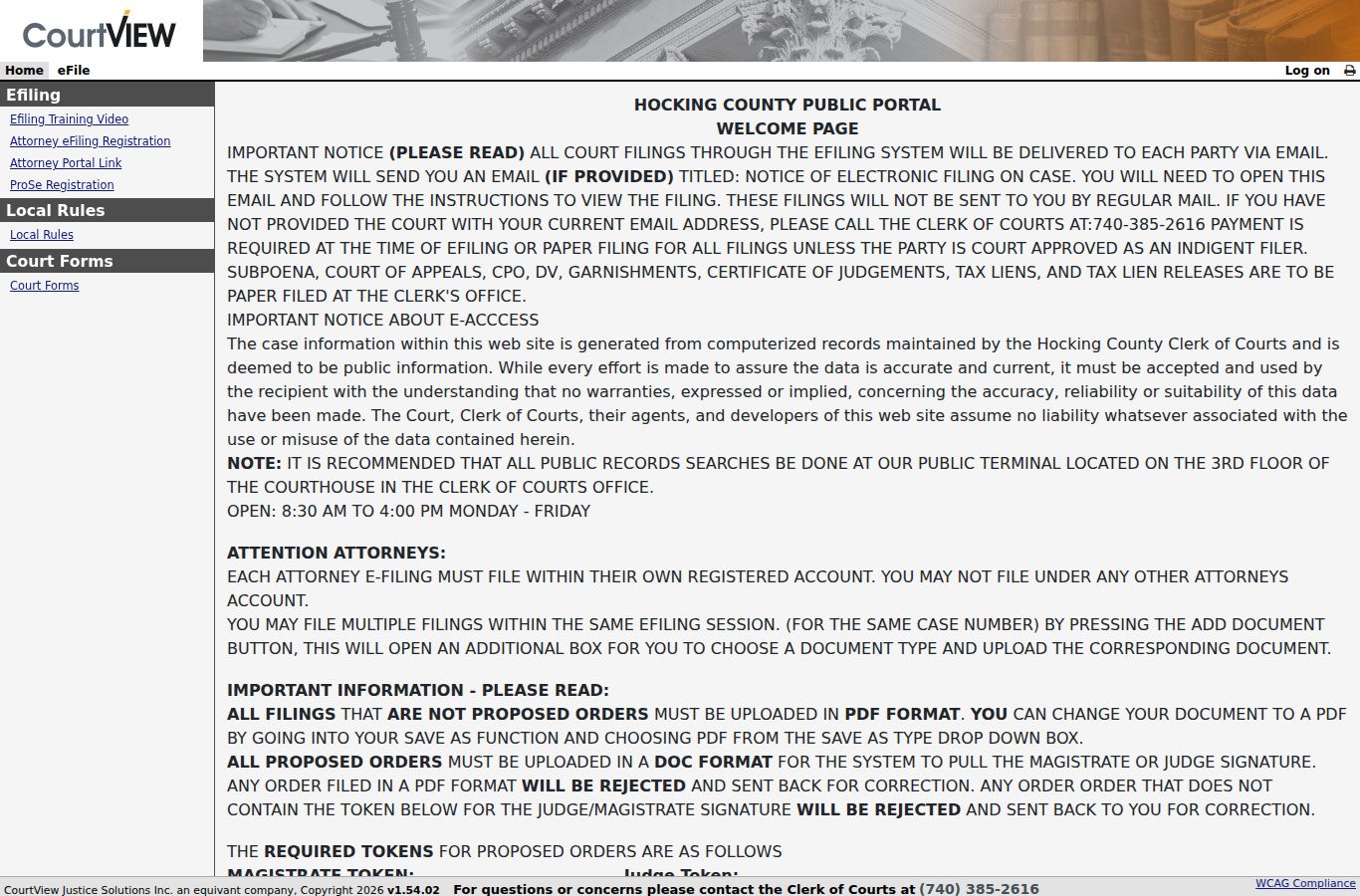
The entry page states its own coverage. That makes it a Common Pleas tool, not one Hocking search box for every trial-court case.
How to Search by Case Number
A court-issued number is usually the fastest route to the matching case. Type the value exactly as printed. Use the summons, citation, notice, entry, or other court correspondence. Hocking’s official pages publish no single local case-number format. A required prefix, year, or sequence cannot be assumed. The only safe generic label is Case Number.
For a Municipal traffic matter, the official form adds a Citation Number field. It also lists Citation Vehicle Tag Number, SAO Case Number, Arresting Case Number, and Warrant Number as separate fields. These labels are distinct, not alternate forms of one prescribed number. A value that fails in one field may belong to another court or identifier category.
Hocking Municipal Case Lookup Fields
The Municipal public search gives a fuller filter list than a simple name-and-number form. Beyond case and citation numbers, it lists vehicle tag, SAO, arresting case, warrant, driver-license, opened and closed dates, party date of birth, court types, causes of action or case types, party types, division, statutes or charges. It also lists attorney file number. No field is marked required. The court publishes no full dropdown inventory or result-refresh time. It makes no promise that document images are free.
Use sensitive identifying fields only in the court’s official form. Use them only when they are needed to tell one case from another. A visible filter does not guarantee a public result. The court form requires JavaScript and separates Search, Court Docket, and Case Lists.
The Hocking Municipal Court Case Search supplies the published field labels.
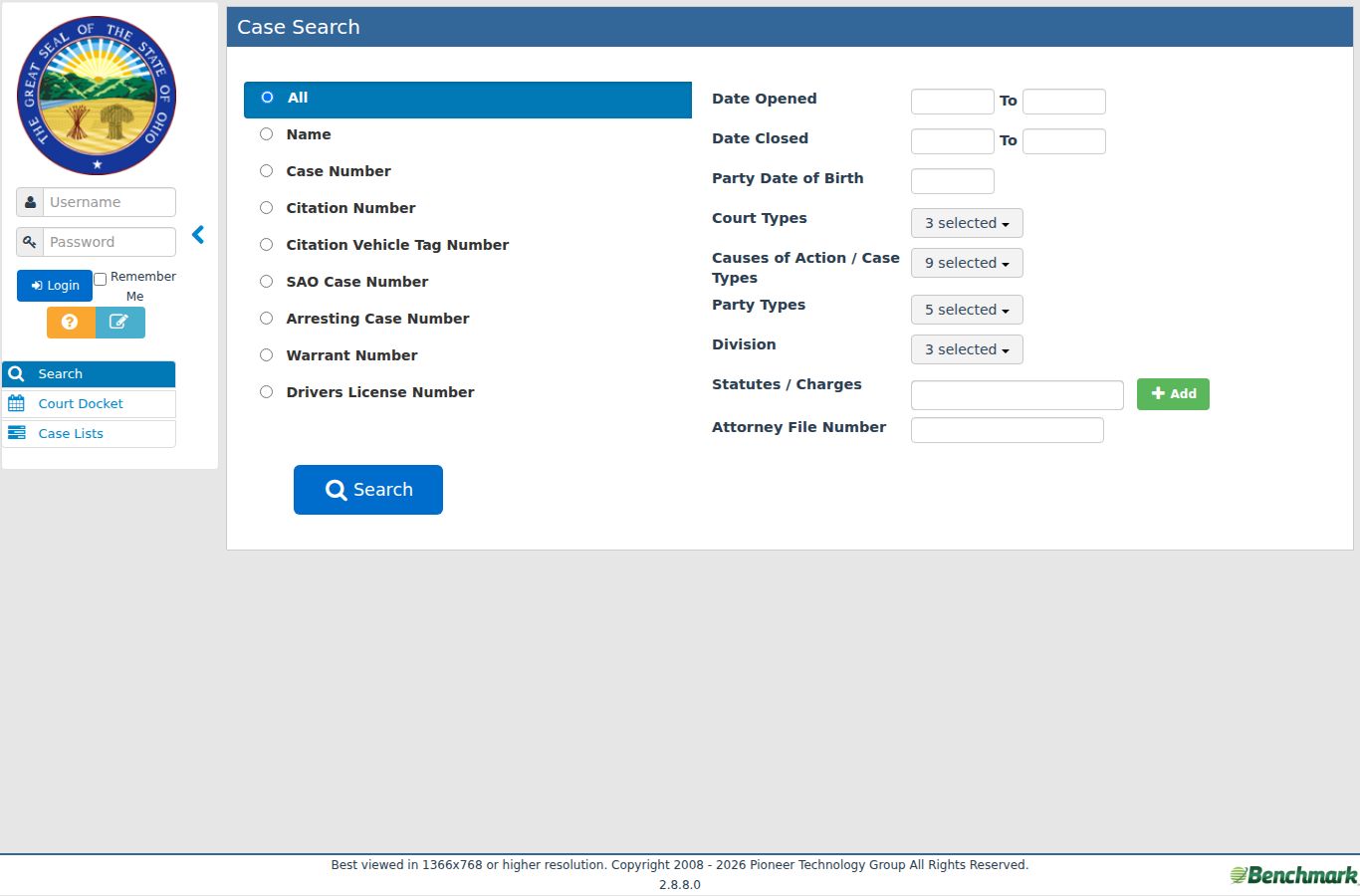
Those filters only help after the right court channel and identifier type are chosen.
What a Case Search Shows
Hocking search results work as a case index and procedural history. What appears depends on the court and its public display. Categories may include the case number, court or division, case type, party roles, opened or closed date, chronological actions, current or prior settings, charges or citation identifiers where applicable. Financial fields and disposition or status may appear too. Exact labels, values, redactions, and document links vary. Do not infer them from a category list.
| Case number | A court-assigned identifier, shown only in the format the particular court publishes. |
|---|---|
| Court, division, and case type | Routing information that distinguishes Common Pleas, Municipal, Probate, or Juvenile record channels. |
| Parties and dates | Publicly displayed party roles and opened, closed, or setting dates where the court makes them available. |
| Case actions | Chronological filings, entries, settings, or other procedural events; a date alone is not a final outcome. |
| Documents or status | May be limited by access rules, processing, redaction, sealing, or the court’s display choices. |
For the underlying file, find the case first. Then go to the clerk or court that holds it. A case result is not a certified record.
Hocking Case Search Date Gates
The Common Pleas Internet Inquiry publishes two historical gates. Ordinary records begin January 1, 1996. Certificates of judgment begin January 1, 2003. A case older than the ordinary series may sit in paper, microfilm, or another clerk-held form. An older domestic matter can also appear online if a post-decree action was filed later. A missing result says nothing about whether an older case exists.
The Supreme Court of Ohio Online Case Docket is a separate court service. It is not a statewide Hocking trial-court search.
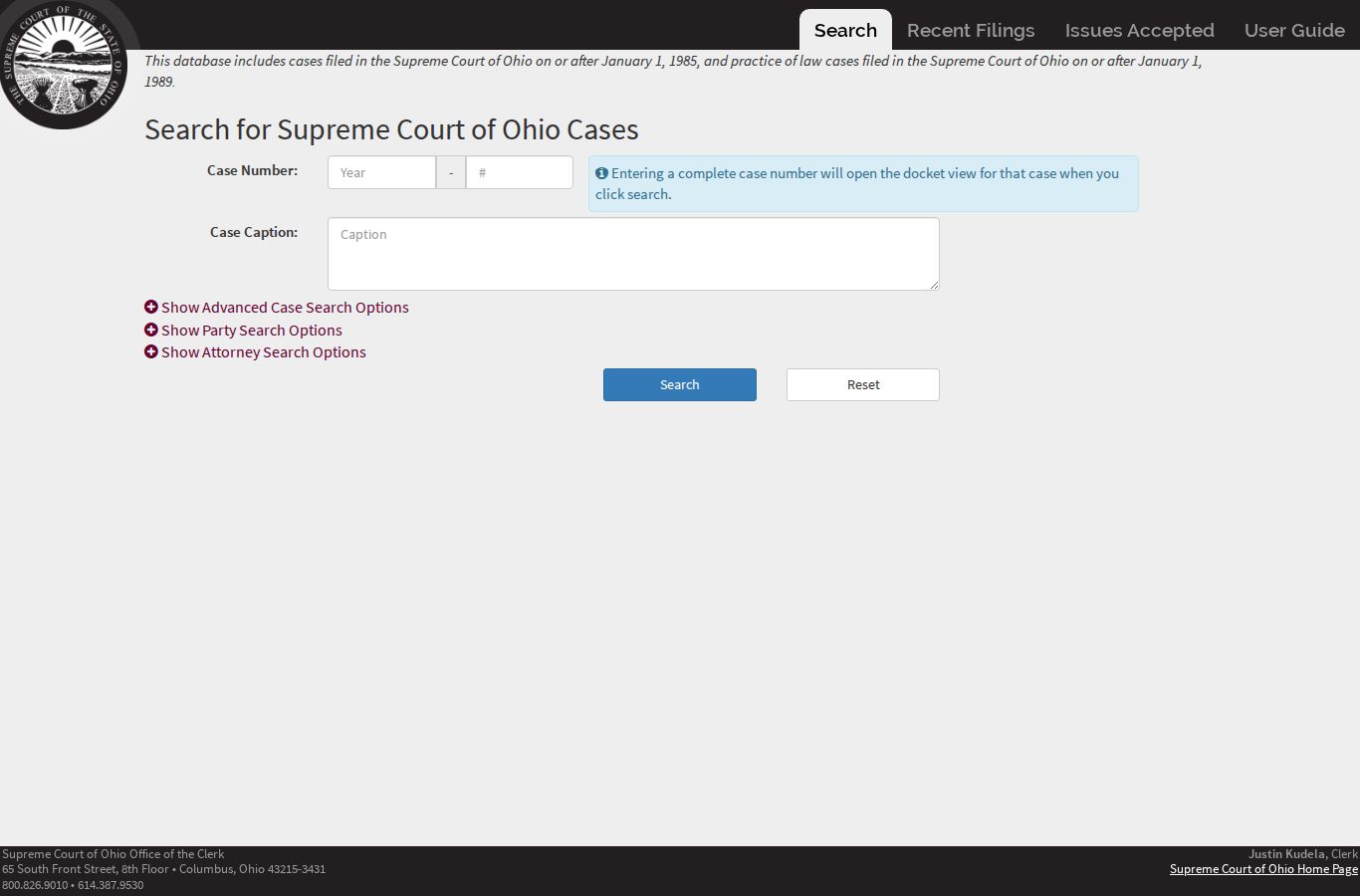
That service can matter for Supreme Court issues. It does not replace the Hocking Common Pleas, Municipal, or Probate search routes.
County vs Statewide Case Search
Ohio has no single statewide portal for trial-court case lookup. The Supreme Court service covers only Supreme Court and practice-of-law matters, so it is not a second source for Hocking trial court results. Every Hocking case search starts with the record-holding county court. Court routing is the answer, not a speculative statewide search.
| Search route | What it covers | When it fits |
|---|---|---|
| Statewide Ohio trial-court portal | No single public trial-court lookup exists | Not an available Hocking trial-court route |
| Supreme Court Online Case Docket | Supreme Court and practice-of-law matters | Only when the case is actually in that court |
| Hocking court portals | Common Pleas, Municipal, or Probate records in their separate systems | The normal route for a Hocking trial-court matter |
Hocking Case Lookup Is Not Certified
What you pull from an online Hocking case lookup is not a certified copy. Think of it as a map, not the deed. The Hocking Common Pleas Local Rules confirm the point. They say e-filed documents reach the public only after processing. Online access is sometimes unavailable or barred. When that happens, the clerk can hand over an unsealed document at a terminal, on paper, or on microfilm. Need certified copies in Hocking County? The Legal Division of the Common Pleas clerk is the office to call on.
Result limit: A no-result may reflect court routing, an older file, processing, access restriction, or a sealed record. It does not prove that a case never existed.
The Municipal side works differently. Record searches there run by fax, email, or the website search, and nothing else. Probate asks anyone who needs verified information to request it from the Probate Court directly, or to come in during regular hours.
Hocking Probate Case Lookup Verification
Hocking Probate CaseLook comes with its own caution. Electronic data can lag filings and judicial actions by at least 24 hours. Sometimes the delay runs longer. The court's verification route is plain. Request the information from the Probate Court, or visit during regular business hours. So the online lookup suits research, while the court itself stands behind verified answers.
Probate also sits in its own branch of Hocking case lookup. Send a Probate question to the Common Pleas Legal Division or the Municipal clerk and the request may stall. Neither office keeps those records. The Probate CaseLook terms and delay notice spell out this separate verification route.
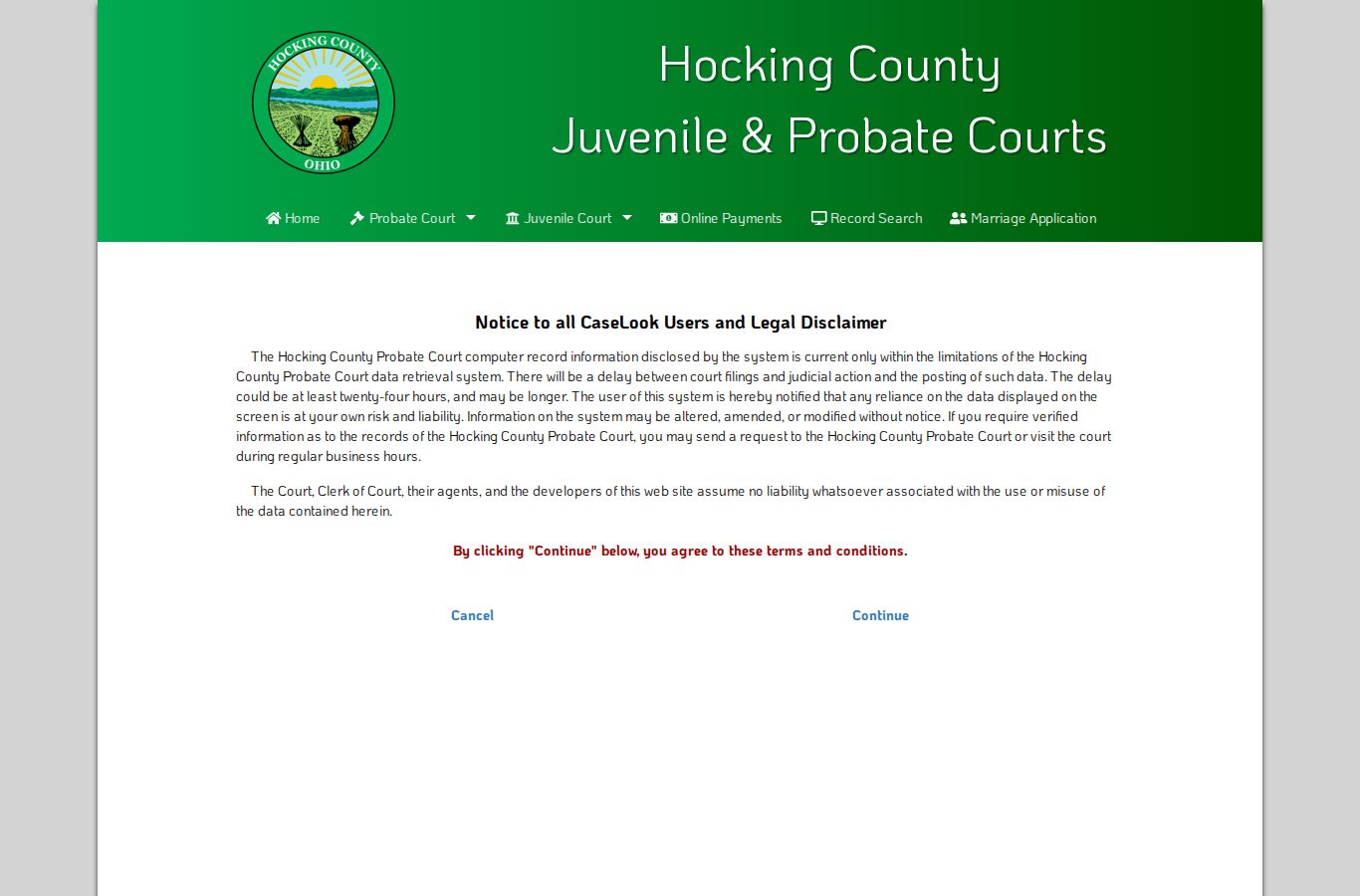
That posted delay matters for time-sensitive matters. Verify a Probate record with the court rather than treating an online result as final.
Hocking Case Search and E-Filing
Hocking Common Pleas files electronically through a county-designated filing manager, as Local Rule 3 provides. That system belongs to filing parties, not the public. It is not the same product as the Clerk's CourtView or eServices Internet Inquiry. E-filed documents appear on the clerk's Internet site after processing. They show up there once they qualify for public access. No EFM vendor name or public filing-login URL is published.
Keeping these two functions apart prevents a common mistake. Someone chasing a public docket should use Internet Inquiry or the local court portal. A filer's login is not a public records search. Reading it as one leads nowhere useful.
Hocking Federal Case Lookup
A federal case runs on a separate track from anything in Hocking County court. Hocking County falls within the Southern District of Ohio for federal coverage. Case access there goes through PACER and the federal court's CM/ECF environment. Neither one touches Common Pleas, Municipal, Probate, or Juvenile records. Figure out which court holds the case before you start a federal lookup. The PACER Southern District of Ohio court lookup shows the applicable federal court. Ask the basic question first. Which system holds your case?
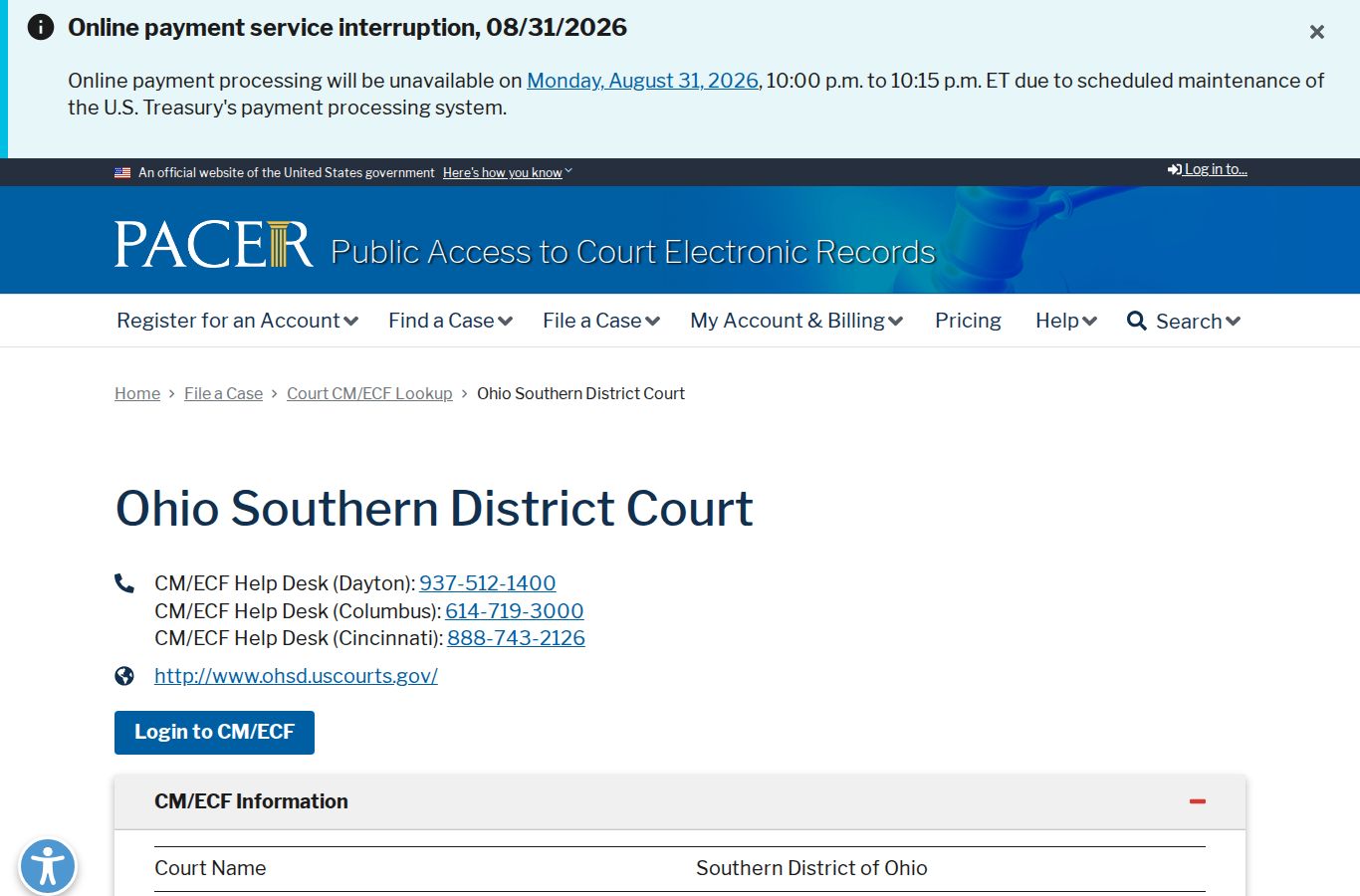
PACER handles federal court records, so it runs alongside, rather than in place of, a Hocking County case lookup.
Hocking Case Lookup Docket Endpoint
The Municipal daily Court Docket endpoint may serve as a calendar channel. It can still return an access-denied response. That page simply does not always open. When it refuses, fall back on the Municipal Case Search, your citation or court notice, and the Municipal Court's official contact channel to confirm the current setting. An access notice is never a case result. Treat it only as a closed door.
Practical fallback: A daily docket page is not the only Hocking case lookup route. The court’s Case Search and the record-holding clerk remain the safer channels when the daily endpoint is unavailable.
Restricted Cases and Access Rules
Not every Hocking record shows up in a public case search. Sealed and expunged matters can be restricted. Most juvenile records are confidential. The local court treats abuse, neglect, and dependency matters the same way. A felony indictment can stay secret until docketed under Hocking Common Pleas Local Rule 44.05. Personal information may also be redacted under Local Rule 2 before a document goes public.
Ohio Rules of Superintendence 44 and 45 govern how court-record access and restriction work. A search can come back empty. The right move then is to ask the record-holding court about lawful access. Reconstructing or republishing restricted information is never the answer.