
Getting Hocking County Court Records
Know the court before you ask for anything. The Hocking County Clerk of Courts, Legal Division, keeps Common Pleas civil, domestic, and felony-criminal files, plus Hocking-origin Fourth District appellate records and certificates of judgment. Municipal Court holds its own countywide set: traffic, misdemeanors, small claims, and limited civil cases. Probate and Juvenile run separate deputy-clerk offices. Each sets its own access rules too.
- Locate the Hocking County case through the appropriate court search or calendar channel, if an online channel covers it.
- Specify whether the need is a docket entry, pleading, order, judgment, transcript, plain copy, or certified copy.
- For Common Pleas, use Internet Inquiry first and then the Legal Division for the public office fallback or a copy request.
- For Municipal records, use the court website search, fax, or email route published by the court.
- For verified Probate information, send a request or visit the Probate office; route Juvenile questions to that division because confidentiality can apply.
The Common Pleas side publishes no general routine for mail, fax, email, online copy orders, payment methods, identification, or turnaround times. Assume none of those steps apply. Call the Legal Division first and describe the exact Hocking County item you need.
Hocking County Court Record Access Ladder
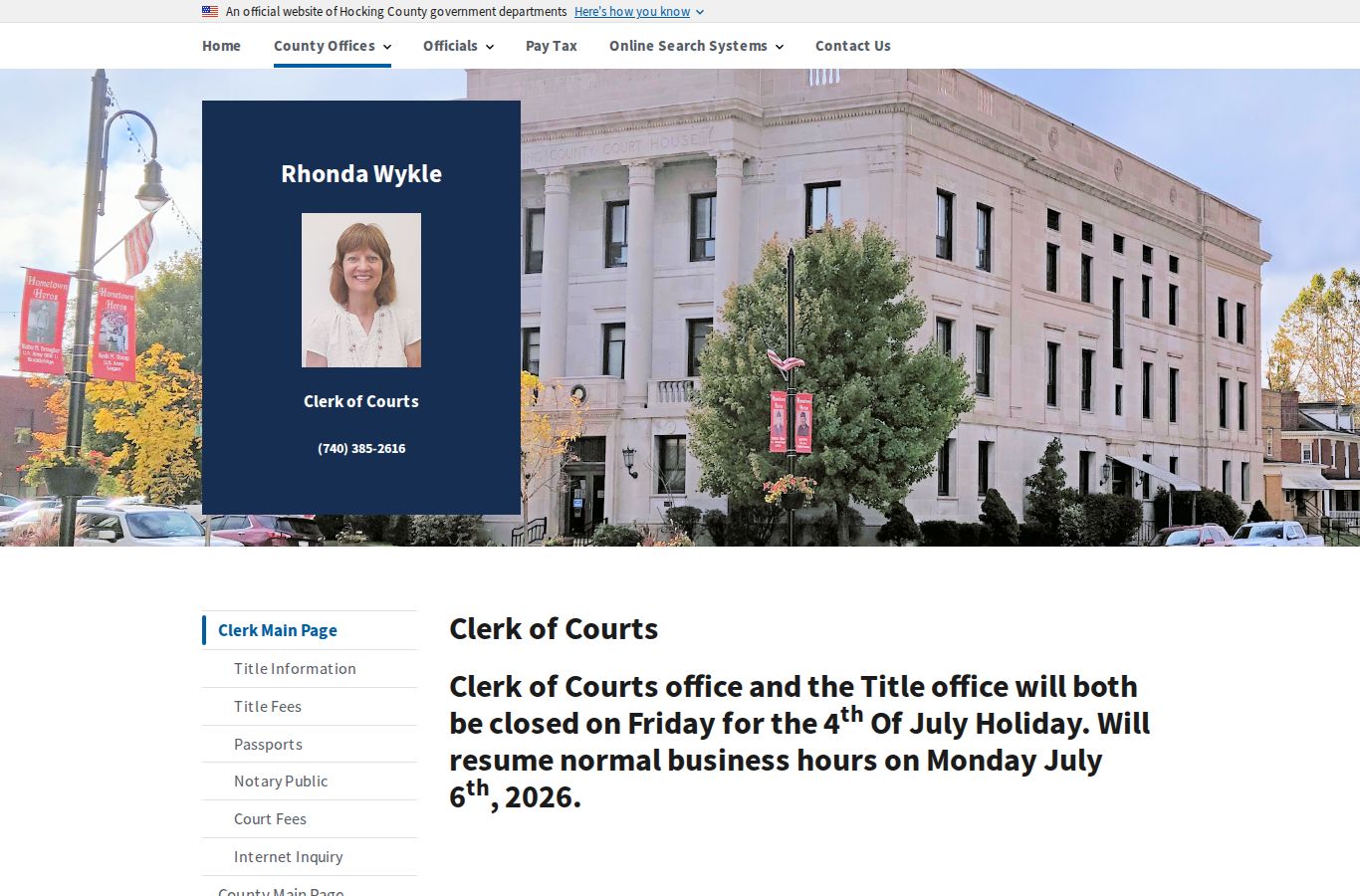
For a public Common Pleas filing, Hocking County works in steps. Start online. The clerk's Internet Inquiry is the entry point. Processed public e-filed documents can show up there. When the site is down, or a document cannot lawfully go online, Local Rule 2 steps in. It calls for the unsealed document to be available at the clerk's office by terminal, paper, or microfilm. Copies and certifications are separate clerk services. The Hocking County Clerk of Courts page names the Legal Division. It also lays out what the Internet Inquiry covers.
Why does the ladder matter? An online result is not the same as the court-held file. A no-result can simply mean the wrong court, an older record, unprocessed paperwork, or a restriction on access.
Court Record Types
A docket listing does not show everything a Hocking County court keeps. The docket itself is the chronological public layer. Pleadings, entries, orders, judgments, transcripts, and exhibits sit beneath it. The record rule and any restriction govern those items. The right division controls the path and decides what can be released.
- Common Pleas public docket activity and processed public case filings.
- Municipal traffic, misdemeanor, small-claims, and civil case records.
- Probate estate, guardianship, marriage, adoption, and related files.
- Juvenile court records, with confidential categories and separate access rules.
- Clerk-certified versions of records held by the responsible Hocking County court.
The court type beats a broad "county clerk" search every time. A Hocking County traffic citation belongs to Municipal Court. A felony or a Common Pleas civil matter belongs to the Legal Division. That division-by-division habit also keeps expectations honest. A Hocking County Probate search can help with estate research. Yet a record showing online is not the same as a verified one. A Juvenile search must respect the court's confidential categories. A Common Pleas filing may be public after processing. Even so, it can still need a Legal Division request for an office copy or certification. Holder, record type, and level of proof decide the channel.
Hocking County Court Record Date Gates
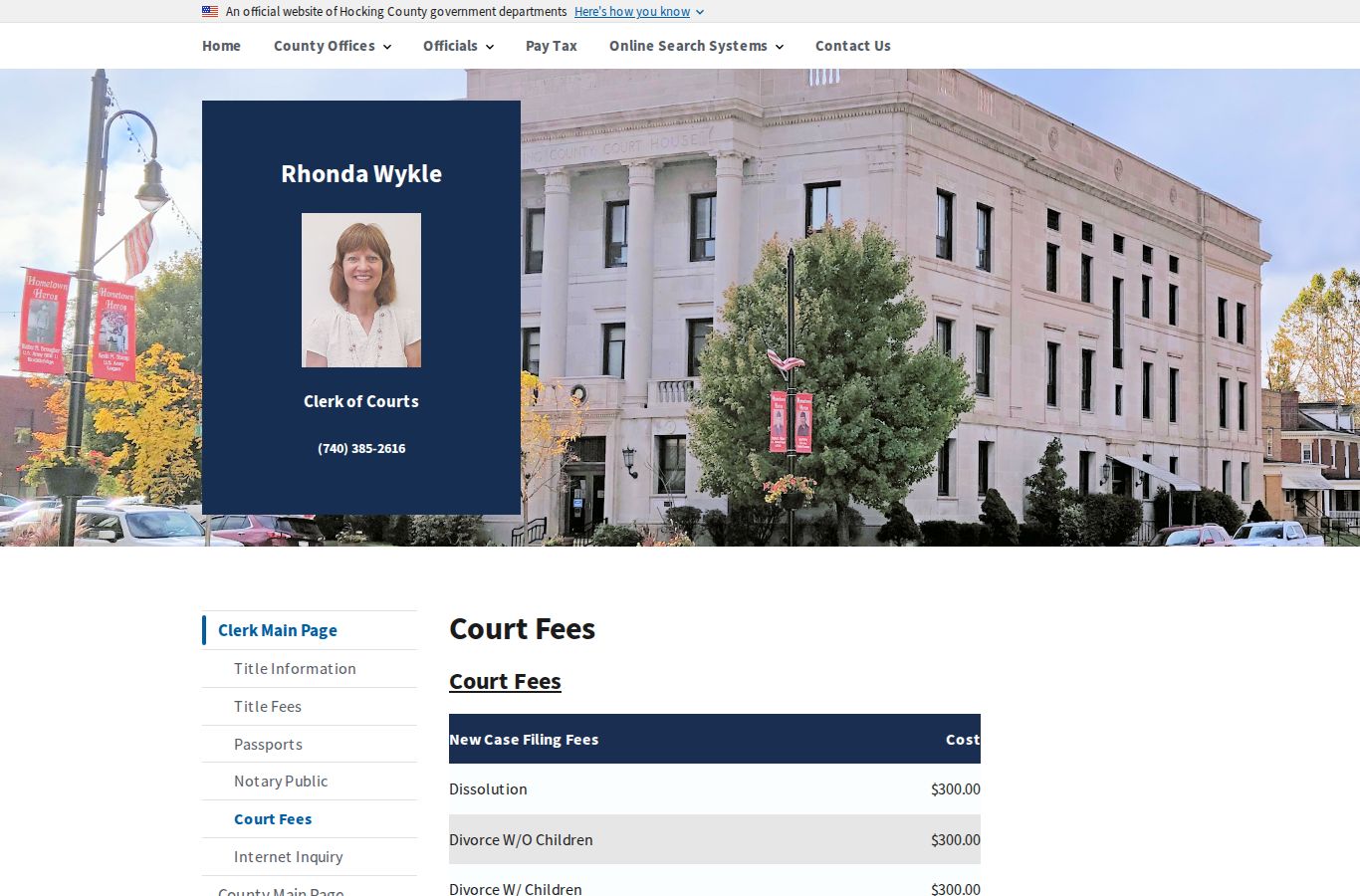
Internet Inquiry does not reach every old Hocking County Common Pleas file. Per the clerk, ordinary public records start January 1, 1996. Certificates of judgment start January 1, 2003. An older domestic case can still show up, though, if a later post-decree action was filed. So a miss on an older matter proves nothing about whether the file existed. The Clerk's Common Pleas fees page is an official county source. It is tied to record copies and certifications.
For an older Hocking County file, ask the Legal Division what paper, microfilm, terminal, or other clerk-held material exists. The Internet Inquiry start date is not a destruction date.
Inside a Hocking County Court Record
A Hocking County court record can hold more than the public search shows. The docket sheet lists entries in order. Pleadings, orders, and judgments form the substance beneath it. Contents vary by case and division. So does public availability, especially where personal information is redacted or an order restricts access.
| Case number | The court's identifier, used to route a Hocking County request to the right division and file. |
|---|---|
| Docket sheet | Chronological entries showing filed activity and scheduled events. |
| Pleadings | Filed papers such as complaints, motions, responses, or applications, when available to the requester. |
| Orders and judgments | Entries that record a court ruling or disposition. |
| Transcript or exhibit | Material that may require a separate court-reporter or clerk process and may be restricted. |
Local Rule 2 bars removing files, depositions, or transcripts from the clerk's office, and bars disassembling them for copying. Inspection in Hocking County means using the clerk's channels, not tearing the file apart as a copy source.
Hocking County Municipal Court Record Channels
Hocking County Municipal Court takes a different route for records. Its General Information page says searches run by fax, email, and website search only. The published email is municipalcourt@hocking.oh.gov. The listed fax number is (740) 385-3826. The Municipal clerk can locate case information and explain procedure, but not give legal advice. The Hocking County Juvenile and Probate Courts page shows the separate division structure. It also carries an access notice.
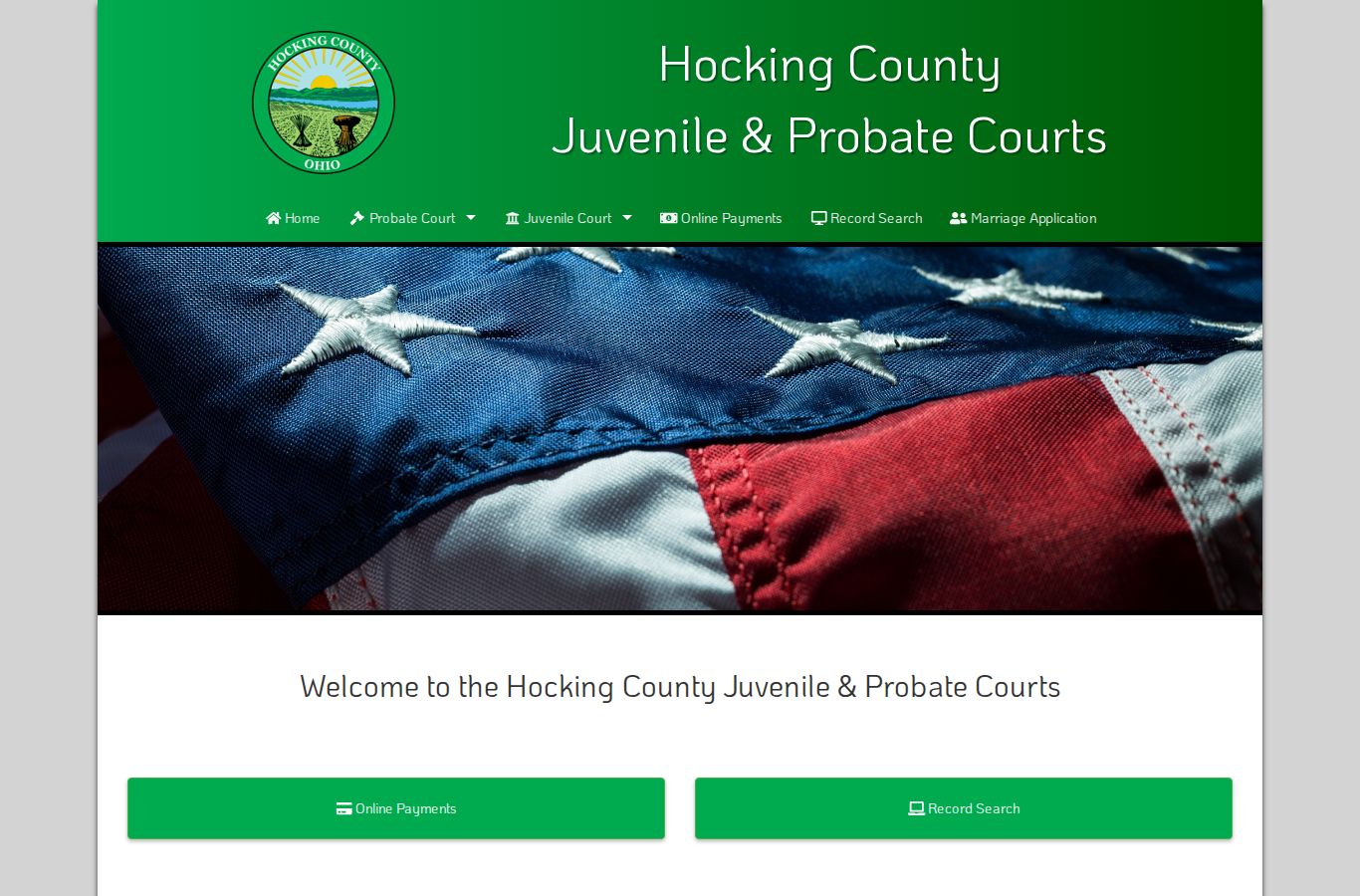
That division split explains a lot of dead ends. Probate and Juvenile records never migrate into the Municipal database just because the person or event happened in Hocking County.
Fees and Certified Copies
Copies come in two flavors at the Hocking County Clerk's Legal Division. Plain ones run $0.25 per page. Certification adds $2 per page on top of that. Those figures cover copying and certifying only, not filing deposits. The Municipal Court's Civil page lists $0.25 per page too. It adds a $1 charge for a certified document. Before treating that $1 as the cost of a traffic record or any other Municipal file, ask the court to confirm the item and the total.
| Record item | Published amount | Important limit |
|---|---|---|
| Common Pleas plain copy | $0.25 per page | Requested through the Legal Division for the item it holds. |
| Common Pleas certification | $2 per page | Use the clerk-held record; no separate flat certification fee was located. |
| Municipal copy | $0.25 per page | Listed on the Civil fee page; confirm application to the requested record. |
| Municipal certified document | $1 listed | Confirm the fee basis and total with Municipal Court. |
Hocking County Clerk of Courts, Legal Division
1 East Main Street
Logan, OH 43138
(740) 385-2616
Monday through Friday, 8:30 a.m. to 4:00 p.m.; closed noon to 1:00 p.m.
Hocking County Probate Court Record History
Hocking County Probate's online search is handy, but it is not a verified-record service. CaseLook data can lag filings and judicial actions by twenty-four hours or longer. Need verified information? Send the court a request or visit in person. For deep historical digging, there is one place to go. That is the Hocking County Records Repository at 105 East Hunter Street. Its shelves hold marriages from 1818 to 1990 and estates from 1820 to 1984. Probate keeps only the previous five years of estates on site. The Probate genealogy and repository guide lists those official Hocking County date ranges. It also shows where each set sits.
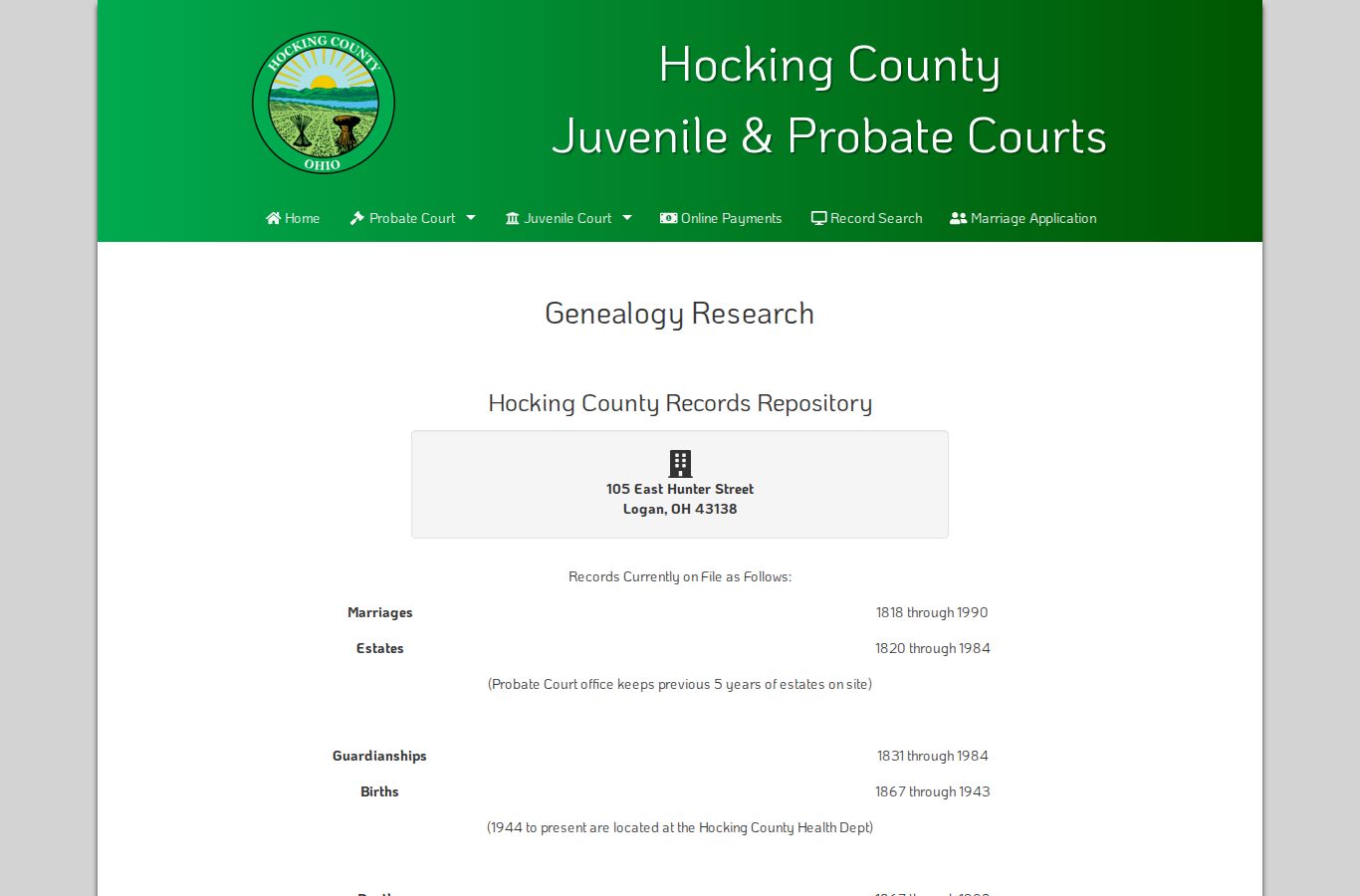
Treat the repository as one focused historical route, nothing more. Hocking County court records from Common Pleas, Municipal, or confidential Juvenile matters are not all stored there.
Sealed Records and Public Access
Ohio starts from a public-record rule. Hocking County files can still carry restrictions. A file may be sealed, expunged, confidential, redacted, or held back from the docket temporarily. Common Pleas documents get their access and privacy rules from Hocking County Local Rule 2. Juvenile treats abuse, neglect, dependency, and most of its matters as confidential. Just because nothing appears online, do not assume a restricted file does not exist. The docket may simply not show it.
Access rules matter. Ohio Rules of Superintendence 44 and 45 define court records and their access framework. Ohio Revised Code 149.43 supplies the public-record baseline. Ohio Revised Code 2953.32 concerns criminal sealing and expungement, while Ohio Revised Code 2151.356 addresses juvenile sealing. These rules do not create a route around a Hocking County restriction.
If you file papers in Hocking County, the redaction duties for personal identifiers fall on you. Request any non-public document from its holder. Then accept the court's access decision. Public access and unrestricted online access are two different things in Hocking County Common Pleas. Local Rule 2 gives the clerk's office a path for an unsealed record. That path applies when web access is unavailable or barred. What it does not do is open sealed or confidential material. A restricted result calls for asking the court about a lawful access route, nothing sneakier.
Hocking County Court Records Beyond State Court
Federal cases tied to Hocking County live outside the county's own systems. The Clerk's Internet Inquiry will not show them. Municipal Court records will not either. Federal civil and criminal dockets are kept by the United States District Court for the Southern District of Ohio, through its PACER and CM/ECF systems. That is a separate court with its own custodian. It is not a wider Hocking County court-record search. The Southern District of Ohio court page helps you tell the federal system apart from Hocking County's state-court record channels.
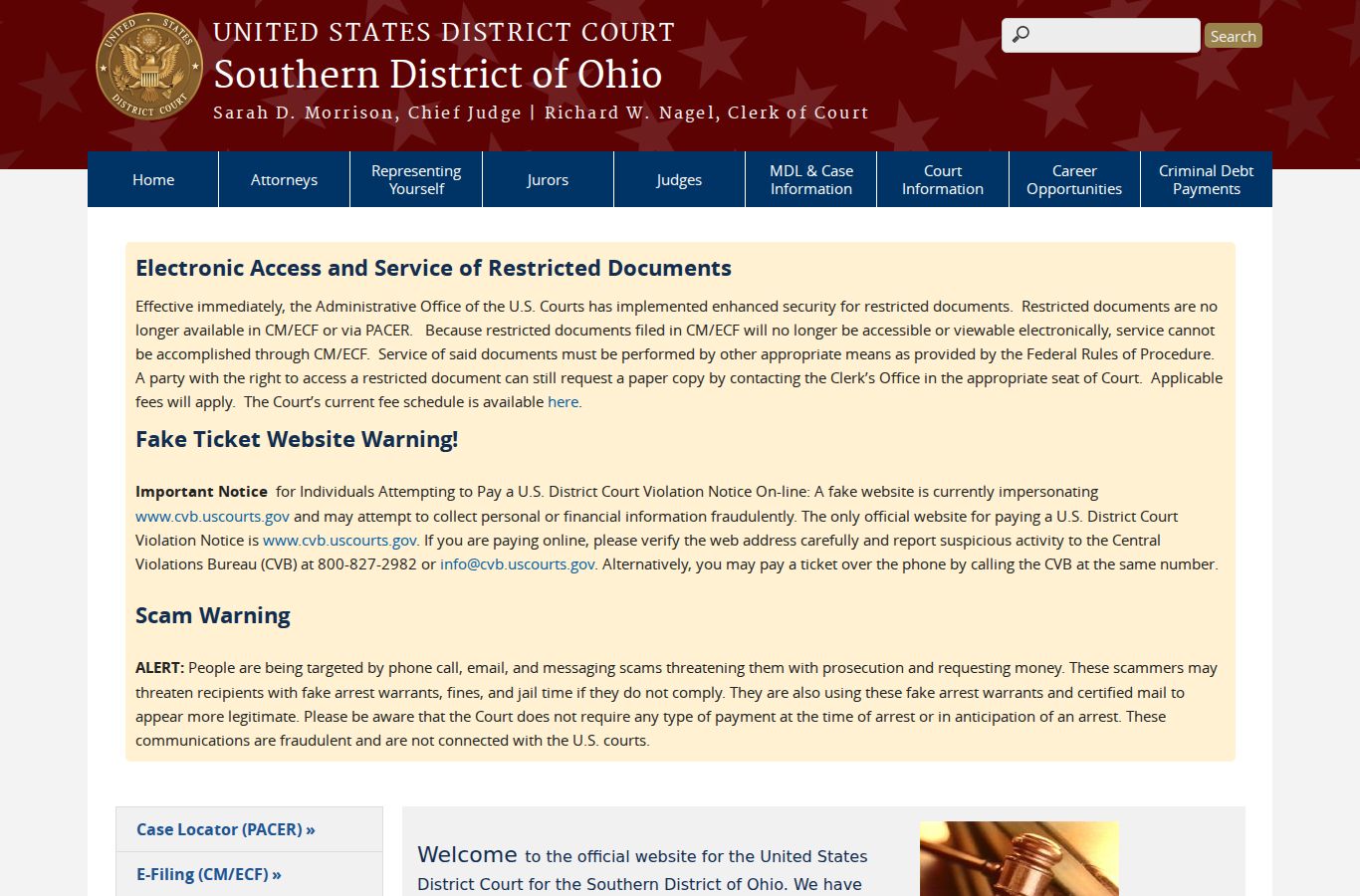
A Hocking County Common Pleas, Municipal, Probate, or Juvenile matter stays with the state-court division that holds the file. PACER is a federal tool, not a county record archive.